How to Choose a Desk Cat Bed: What to Check Before You Buy
In short
Four things to measure before you buy, and one thing no bed can promise: whether your cat will actually use it.
Ignore the photos and check four things before you buy a desk cat bed: whether your cat fits inside, what weight the bed is rated for, whether the clamp opens wide enough for your desktop, and how it will sit on the edge of your particular desk. There is a fifth thing that no purchase can settle: a cat is entitled to ignore any bed you buy, so her temperament and the spot you choose matter more than the model.

Will your cat actually fit?
This is where most beds let people down. Even in roundups from big publications, reviewers keep noting that a model is too snug for a larger cat, and some have an entrance that is simply too narrow. In the product photo the bowl always looks roomier than it turns out to be in your living room.
So measure at home. Watch how your cat sleeps: curled into a doughnut, or stretched out like a rug. Cut a square of cardboard to the size of the bowl you are considering and put it on the floor. If your cat steps onto it and settles, the bed will work. If she sniffs it and walks away, neither a soft cushion nor beautiful wood will change her mind.

What weight is the bed rated for, and what does that number mean?
An average adult domestic cat weighs between 3.6 and 5.4 kg (8 to 12 lb), most of them around 4.5 kg. Large breeds run heavier: according to PetMD, male Maine Coons can weigh 5.4 to 9 kg and up (12 to 20 lb or more). Compare the number in the product description with your cat's weight on the scales, not with your impression of her.
The worst case is no number at all. In one large roundup of desk cat beds, only two of ten models list a cat weight limit, and none says how much weight the desk itself can take. That does not make the others unsafe. It means you have nothing to compare against.
One more thing to remember: a cat does not lie down on a bed, she jumps into it. On landing, the load is higher than the weight on the scales, so a bed with some margin is better than one rated right at your cat's limit.
Will the clamp work on your desk?
Start with thickness. A cat bed that attaches to your desk with a clamp needs no drilling, but clamps open to different widths, and many listings do not state the maximum tabletop thickness at all. Measure the edge of your desk with a ruler before you order anything.
Then look at the edge itself. One independent review of a desk-mounted bed warns that if the desk has a small raised lip, the clamp and the bed can start pulling against each other, and the bed can drop when the cat jumps in. The clamp should seat firmly along its full surface, and the bed should sit over the desktop, not beyond its edge. Run your hand along the underside of your desk: if the edge is flat, the clamp will seat fully. If there is a ridge or a lip, it is better to choose another spot, or another solution.
Wood or fabric: what changes?
Fabric and folding models are light, and reviews of them mention the same problems: they lose their shape and can tip if a cat leans on one side. A wooden base is heavier and holds its form. On its own, though, wood is cool to the touch, which is why a soft cushion matters so much.
Warmth matters to cats more than most of us expect. International Cat Care notes that cats prefer a raised bed, and in cooler climates one near a heat source or sunlight (International Cat Care). People in online discussions describe exactly this: the cat sits on the laptop while it is on, and leaves once it cools down. If your cat always picks the warmest place in the room, put the desk near the window, or pay attention to where it is warm in the afternoon.

What if your cat refuses to lie in it?
This is the most common disappointment, and it has little to do with the quality of the bed. In discussions among people who work from home with cats, the same story comes up again and again: the cat ignores the spot made for her and walks straight onto the keyboard, because that is where your attention is. One commenter put it neatly: cats can tell when something was made for them, and refuse it, while an old cardboard box remains a palace.
What actually helps:
- Location beats the bed. Many people do not mount anything on the desk at all. They put a bed or a chair next to it, within reach of a hand, so the cat is close but not on the keyboard. Cats like height, so a raised spot near you works better than a low nook.
- A familiar smell. International Cat Care recommends not washing bedding too often, so it keeps a smell the cat knows. Put in something that smells of you, or a blanket she has already slept on.
- Time. Some cats take to a new bed in a few days, others need longer. One commenter wrote that their cat ignored two new beds, and another month passed before she even looked at them again.
- Attention first, work second. VCA suggests playing with your cat and giving her something to do before you sit down to work (VCA).
To be honest: a bed will not cure keyboard walking. It gives her a spot more interesting than the keyboard, but the decision is hers.

What the numbers look like in practice
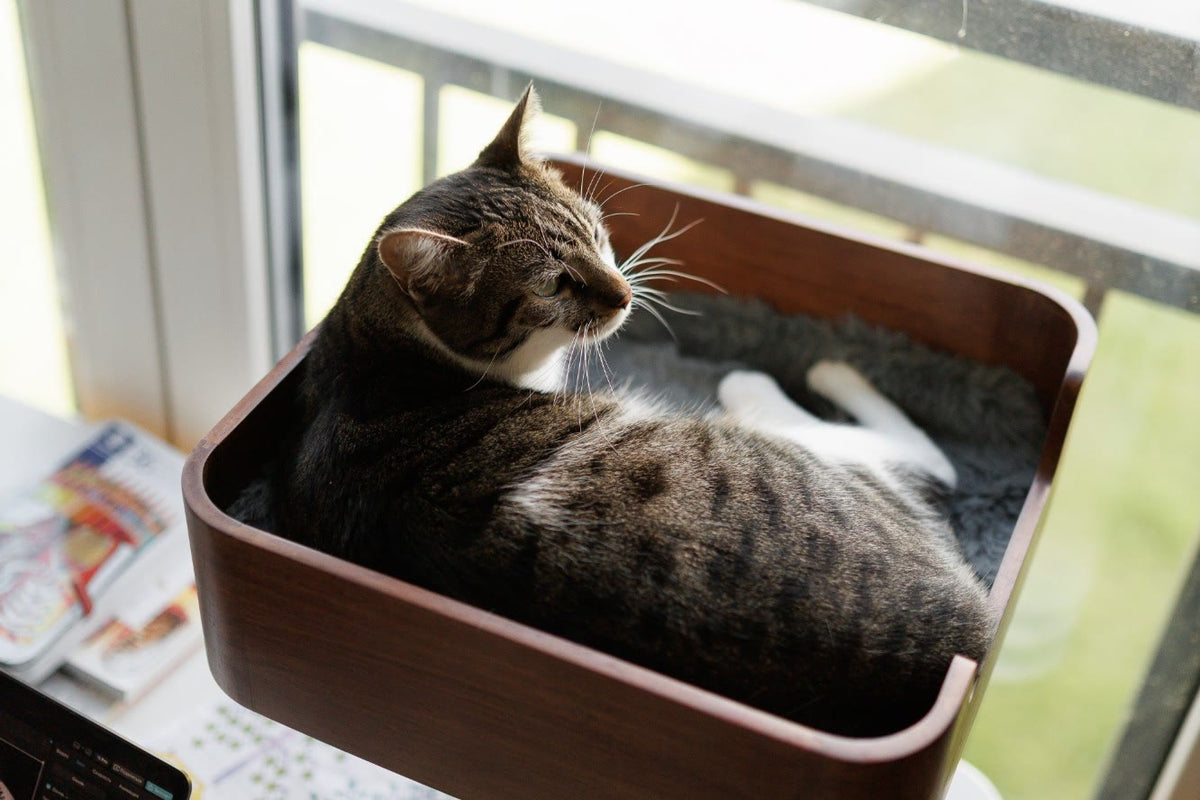
You can check all of the above on any model. For comparison, here is how they look for the Catomi Desk Cat Bed: the bed measures 37 × 37 cm on the outside (about 14.5 in), the sleeping area inside is 35 × 35 cm, about 50 cm across the diagonal, the walls are 13 cm high and the cushion is 35 × 35 cm; it is designed for cats weighing up to 9 kg; the clamp tightens all the way and fits desktops up to 9 cm thick, with no drilling; and the bowl rotates 360° and locks in place after turning. A soft plush faux rabbit fur cushion adds warmth for your cat, so it is warmer than bare wood, and the base is solid hevea wood (rubberwood).
When a desk mounted bed is not the right choice
- Your cat has trouble jumping. Stiffness, limping or difficulty jumping is a reason to see a vet, not to buy a higher bed. International Cat Care recommends steps and gentle ramps to favorite spots for older cats (International Cat Care). A high bed only helps if the cat can climb up and get down easily.
- Your cat weighs more than the bed is rated for. Choose another solution rather than something rated right at her weight.
- You have several cats. One bed for two cats quickly becomes an argument. Plan for different spots and one spare.
- The edge of your desk will not let the clamp seat. Solve that first, then buy.
Frequently asked questions
Do I need to drill into my desk? Not with a clamp-on bed: the clamp grips the edge. Do check the thickness of your tabletop and the shape of its edge.
Will it fit a thick desk? It depends on the model. Look for the maximum tabletop thickness in the description and compare it with your own.
Can the bed rotate? Many can. It lets you choose the angle from which your cat watches the room. Check whether the bowl locks in place after you turn it.
Is it suitable for a large cat? Check both the weight rating and the size of the bowl. Males of large breeds reach 9 kg and more, and they need a bed with margin.
How do I get my cat to use it? Put in a blanket she knows, place the bed where she already spends time, and give her time, days or sometimes weeks. Never put her in it by force.
If you decide to try one
You can see the details of the Desk Cat Bed and the ordering terms on the product page.